
Information Technology · itatlas.ai
The reference layer for Information Technology.
IT Atlas explains how enterprise IT actually fits together, addressing and routing, directories and tokens, hypervisors and landing zones, detection and recovery, as one connected structure rather than a list of products. Vendor neutral, technically precise, and written for the people who operate and design these environments.
- Standards aligned
- Vendor neutral
- Defence oriented
- Practitioner written
- 163
- Topic articles
- 158
- Reference entries
- 17
- Guided routes
Across twelve layers of the estate
Glossary, protocols, technologies and frameworks
Learning paths and troubleshooting flows
380 indexed entries across topics, glossary, protocols, technologies and frameworks.
One connected system
A single question travels through the atlas in one direction. Each stage links to the next, so you never end up with a definition and no idea what to do with it.
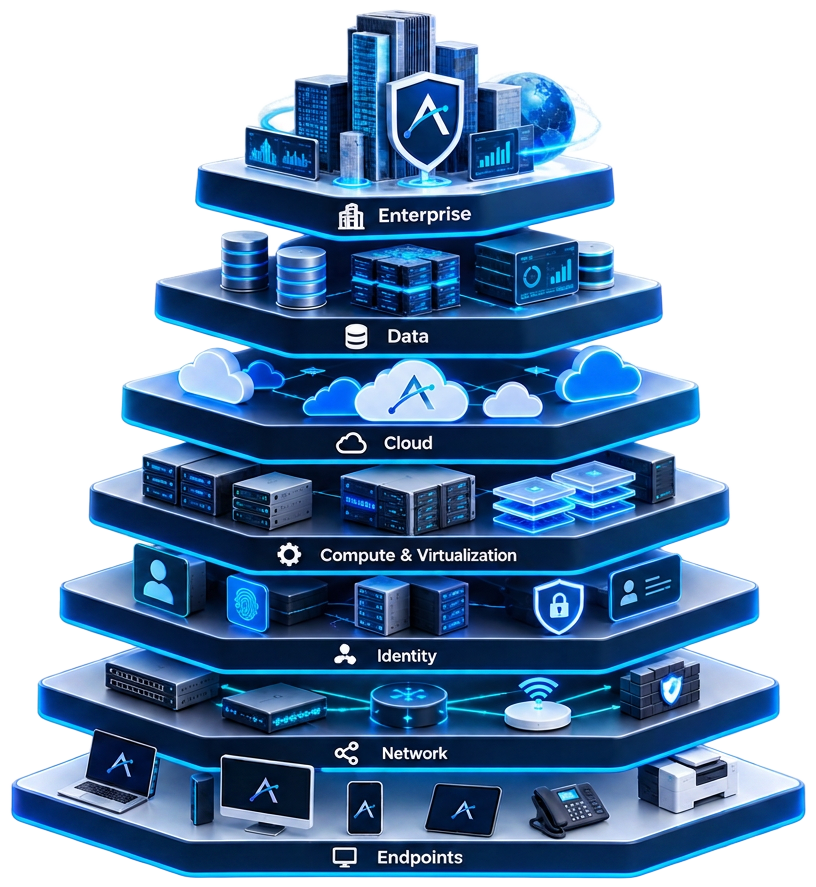
The enterprise IT stack
Operational Technology has the Purdue model. Information Technology has no single canonical diagram, so IT Atlas uses this one: seven dependency tiers that every article is filed against. Select a tier to see what lives there, what it relies on, and how it typically fails.
Identity & access
Directories, authentication, tokens, conditional access, privileged access and lifecycle joiner mover leaver processes. In a cloud era estate, identity, not the firewall, is the perimeter, and identity compromise is the shortest path to everything above and below it.
What lives here
- Depends on
- Network reachability and a trusted device signal
- Typical failure
- Standing privilege, legacy authentication left enabled, or a token stolen after MFA has already passed.
Read next
Where are you today?
Six starting points, by the work you are actually doing.
New to IT
You know the words but not how they connect, and you want the model before the products.
Support & service desk
You are diagnosing something now and need a structured path rather than a forum thread.
Infrastructure & network
You are designing or changing addressing, routing, virtualisation or storage.
Security & identity
You are reducing exposure, tightening identity, or evidencing controls.
Architecture & strategy
You are choosing a target state and need the trade offs stated plainly.
Leadership & governance
You are accountable for risk, spend and compliance rather than configuration.
The lifecycle the atlas supports
Fourteen stages from first inventory to continuous improvement. Most environments are strong in a few and silent in the rest.
- 01DiscoverEnumerate assets, identities, data and dependencies.
- 02ClassifyRank systems and data by business impact.
- 03BaselineRecord the current configuration and its gaps.
- 04AssessMeasure against a chosen framework, not a feeling.
- 05DesignChoose a target architecture and state the trade offs.
- 06SegmentDecide what may reach what, and enforce it.
- 07HardenApply configuration baselines and remove standing privilege.
- 08ImplementDeploy as code, with change control and rollback.
- 09MonitorCollect telemetry that answers real questions.
- 10DetectTurn telemetry into rules, coverage and alerts.
- 11RespondContain, eradicate and communicate under a tested plan.
- 12RecoverRestore from protected backups within agreed objectives.
- 13ReviewRun blameless post incident and post change reviews.
- 14ImproveFeed findings back into design and baselines.
The layers of an IT environment
Every article in IT Atlas sits in one of these sections. Follow the dependencies downward when designing, and upward when troubleshooting.
IT Fundamentals
Start hereThe vocabulary, layers and mental models that everything else in IT Atlas builds on.
Concepts · Comparisons · Models
Infrastructure
Compute, storage, resilienceServers, virtualization, storage, data centres, backup, high availability and disaster recovery, the physical and virtual foundation everything else runs on.
Servers · Virtualization · Storage · Data Centers
Cloud
Platforms and service modelsService models, hyperscale platforms, cloud networking, identity, governance and cost management, explained by architecture rather than by product catalogue.
Cloud Fundamentals · Azure · AWS · Google Cloud
Networking
How systems reach each otherAddressing, routing, switching, name resolution, segmentation, remote access and the protocols that carry enterprise traffic.
Fundamentals · Protocols · Routing & Switching · Segmentation
Security
A layer, not a siloSecurity architecture, Zero Trust, detection and response, vulnerability and patch management, monitoring and incident handling across every other layer.
Security Architecture · Zero Trust · Detection & Response · Security Operations
Identity
The modern control planeDirectories, identity providers, authentication and authorization protocols, conditional access, privileged access and identity governance.
Directories · Authentication · Authorization · Federation
Endpoints
Devices and their lifecycleOperating systems, device management, enrolment, configuration, compliance and the full procure to retire endpoint lifecycle.
Operating Systems · Endpoint Management · Mobile · Compliance
Applications & Data
What the business actually usesEnterprise applications, SaaS, APIs, databases, analytics platforms, collaboration and the data they create and consume.
Enterprise Applications · SaaS · APIs & Integration · Databases
Operations
Keeping the environment healthyIT operations, service management, monitoring and observability, asset management, automation and documentation.
IT Operations · Service Management · Monitoring · Asset Management
Governance
Direction, policy and riskIT governance, policy hierarchies, risk management, access and data governance, vendor management and compliance.
IT Governance · Policy · Risk · Data Governance
Platforms
Ecosystems in contextVendor ecosystems explained structurally: what each service does, where it sits, and how the pieces depend on one another.
Microsoft 365 · Microsoft Security · Vendor Ecosystems
Architecture
Reference designsReference architectures and architectural patterns for networks, identity, security, cloud and resilience.
Enterprise Architecture · Network Architecture · Identity Architecture · Security Architecture
Start here
Foundational articles that most other topics reference.
What is Information Technology?
The systems, platforms and practices used to store, process, transmit, secure and manage information in support of an organisation's work.
ReadOSI Model
A seven layer conceptual model that separates network communication into distinct, independently replaceable functions.
ReadTCP/IP
The protocol suite that actually runs the internet and virtually every enterprise network, organised into link, internet, transport and application layers.
ReadDNS
The Domain Name System is the distributed, hierarchical directory that resolves names to addresses and service records for nearly every other service.
ReadDHCP
Dynamic Host Configuration Protocol automatically issues IP addresses and network configuration to clients as they join a network.
ReadVLANs
Virtual LANs partition one physical switched infrastructure into multiple isolated layer 2 broadcast domains.
ReadReference desks
Advisories & news
Live security advisories, vendor bulletins and platform engineering trends, read straight from CISA, NCSC, Microsoft, AWS, Google, Red Hat and Cloudflare.
Knowledge graph
431 entities and 1442 relationships connecting topics, vendors, technologies, protocols, ports, threats and controls.
Protocols & ports
36 entries with transport, encryption status and the security considerations that matter for each.
Glossary
66 acronyms and terms defined without circular jargon, each linked to the topic that explains it.
Technology directory
46 platforms and products classified by function, deployment model and licensing, with no rankings.
Frameworks & standards
NIST CSF, CIS Controls, ISO 27001, ITIL, COBIT and ATT&CK: what each is for and how they relate.
IT is not OT
The two domains share vocabulary and almost nothing else. IT Atlas covers Information Technology only; Operational Technology has its own platform.
| Dimension | Information Technology | Operational Technology |
|---|---|---|
| Priority order | Confidentiality, integrity, then availability | Safety and availability, then integrity, confidentiality last |
| Consequence of failure | Data loss or disclosure, outage, financial and reputational harm | Physical harm, environmental release, equipment damage, lost production |
| Asset lifetime | 3, 7 years, SaaS changes continuously | 10, 30 years, often past vendor support |
| Patching | Routine and automated on monthly cycles | Rare, vendor validated, scheduled around plant outages |
| Protocols | TCP/IP, HTTPS, DNS, Kerberos, SAML, OIDC, SMB, LDAP | Modbus, DNP3, PROFINET, OPC UA, IEC 61850, CIP |
| Testing | Authenticated scanning and penetration testing are standard | Active scanning can fault controllers; passive monitoring is the default |
| Dominant frameworks | NIST CSF, CIS Controls, ISO 27001, ITIL, ATT&CK Enterprise | IEC 62443, NIST SP 800-82, ATT&CK for ICS, Purdue model |
How IT Atlas is written
Reference material, not sales content.
Nothing here is ranked, scored, sponsored or recommended. Products are described by the function they perform, standards are cited as primary sources, and common failure modes are treated as first class content because that is where practitioner time actually goes. Where a simplification would mislead, the article states the real behaviour instead.
Editorial principles- Scope
- Information Technology only, across twelve layers of the estate.
- Method
- Structured data with typed fields, so every article states what it depends on.